


RELEASE
ARTICLE


The FDA has approved Leqembi Iqlik, the subcutaneous (SC) formulation of the amyloid beta-directed monoclonal antibody lecanemab, for once-weekly initiation dosing in patients with Alzheimer's disease (AD). The SC formulation was previously approved only for maintenance treatment in patients who had received IV lecanemab for at least 18 months.1
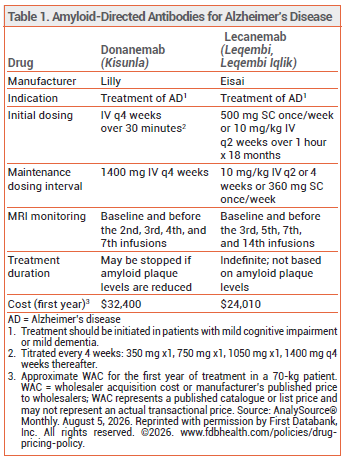
CLINICAL STUDIES — FDA approval of the new SC starting regimen was based on data from substudies of the open-label CLARITY AD extension trial that found that lecanemab exposure with once-weekly subcutaneous injection was similar to that with IV administration of the drug.2
SC administration of lecanemab was associated with less frequent systemic reactions than IV administration, but severe localized reactions leading to treatment discontinuation have occurred with the SC formulation. The risk of amyloid-related imaging abnormalities with the two formulations is expected to be similar.
DOSAGE AND ADMINISTRATION — Leqembi Iqlik is available in single-dose 250 mg/1.25 mL and 360 mg/1.8 mL autoinjectors. The SC starting dosage is 500 mg (given as two 250-mg injections) injected once weekly into the abdomen, thigh, or back of the upper arm. After 18 months, maintenance treatment with lecanemab 10 mg/kg IV every 2 or 4 weeks or 360 mg SC once weekly should be initiated. The SC injection can be administered at home by the patient or caregiver.
- In brief: Updates for lecanemab (Leqembi) for Alzheimer's disease. Med Lett Drugs Ther 2025; 67:182.
- MC Irizarry and L Reyderman. Lecanemab subcutaneous formulation for maintenance dosing: the potential of a new and convenient option for ongoing treatment in early Alzheimer's disease. Alzheimer's Association International Conference (AAIC) 2025; Toronto, ON; July 27-31, 2025.